
YNAB costs $109 a year. That’s more than Netflix. It has a learning curve that takes most people two to three months to get through. And if you’re the wrong kind of user, it’ll collect digital dust next to your other abandoned finance apps.
But if you’re the right kind of user? It’s the best $109 you’ll spend on your money all year.
Here’s how to figure out which one you are before handing over your credit card.
The Four Rules (And Why They’re Different From “Track Your Spending”)
YNAB isn’t a tracker. Most people download it expecting a prettier version of Mint and bounce off it in week two. The disconnect is that YNAB is built on four opinionated rules about how you behave with money, not just how you observe it.
Rule 1: Give Every Dollar a Job
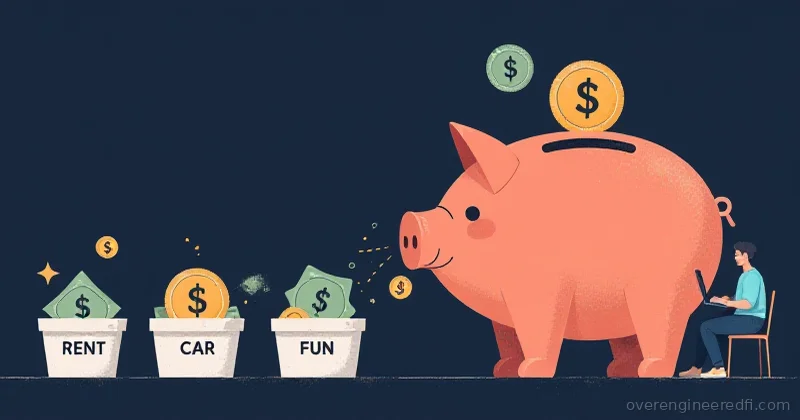
Before you spend, every dollar in your checking account gets assigned to a category. Rent, groceries, car insurance, travel fund, whatever. The goal is to get to zero, not a negative balance, but a situation where every dollar you have is spoken for.
This is called zero-based budgeting, and it feels uncomfortable at first. You’re used to checking your bank balance and thinking “yeah, that looks fine.” YNAB forces you to answer a harder question: fine for what, exactly?
Rule 2: Embrace True Expenses
This is the one that actually changes behavior. Your car insurance is $1,200 a year. Most budgets treat that as a $1,200 surprise every twelve months. YNAB treats it as a $100/month expense that you’re setting aside consistently.
Same goes for: annual subscriptions, holiday gifts, irregular medical bills, car maintenance, vet bills, home repairs. You take the annual number, divide by 12, and fund the category every month. When the expense hits, the money’s already there.
It sounds obvious. It isn’t obvious until you’ve been surprised by a $600 car repair three months in a row.
Rule 3: Roll With the Punches
You budgeted $400 for groceries. You spent $540. In most budgeting systems, this means you failed. In YNAB, it means you move $140 from another category to cover it, guilt-free, without starting over.
The insight here is that your budget isn’t a moral document. It’s a plan, and plans change. YNAB expects you to adjust categories in real time rather than either abandoning the budget entirely or lying to yourself about whether you stayed on track.
Rule 4: Age Your Money
This is the long game. The goal is to spend money that’s at least 30 days old, meaning you pay July’s bills with June’s income, not with the paycheck that just hit your account.
If you’re living paycheck to paycheck, your “age of money” is essentially zero. Every expense comes out of money that arrived in the last few days. YNAB tracks this metric and the idea is to increase it over time, building a buffer so you’re never scrambling.
When you hit 30+ days, you’ve broken the paycheck-to-paycheck cycle. That’s the finish line for a lot of YNAB users.
Who Actually Benefits From YNAB
YNAB works best for specific situations. If you’re in one of these, it’s worth taking seriously:
You’re living paycheck to paycheck. The app was built for this. Rule 4 is designed to walk you from zero buffer to one-month buffer to full financial stability. The cash-flow clarity alone is worth the price.
You’re in debt payoff mode. When every dollar needs to work toward a specific goal (kill the credit card, fund the emergency account), YNAB’s category system lets you see progress in real time. It’s motivating in a way that spreadsheets often aren’t.
You and a partner have different spending habits. Shared budgets are a relationship stress test. YNAB’s collaborative features let both people see the same budget in real time, which removes a lot of “I didn’t know we were out of money in that category” arguments.
You consistently have money but don’t know where it went. High income, mysteriously empty checking account. If you earn $150k and still feel broke, YNAB’s envelope system will answer the question faster than any retrospective tracker.
You want to feel in control of every dollar. Some people are just wired this way. If you get anxious when you don’t know exactly where your money stands, YNAB’s zero-based approach gives you that certainty.
Who Should Skip It
The other side deserves a look too.
You already have a solid savings rate and just want visibility. If you’re maxing your 401k and HSA, hitting your savings targets every month, and just want a dashboard to see where your spending went, YNAB is overkill. The active budgeting requirement will feel like busywork. Use Monarch Money instead. It connects your accounts passively, categorizes transactions, and gives you spending reports without demanding you assign every dollar before you spend it.
You hate manual processes. YNAB’s bank sync is decent but it works best when you’re reviewing and approving transactions regularly. If you want to connect accounts and never open the app again, this tool isn’t for you.
You’re already optimized. If your money is automated, savings auto-transfers on the 1st, investments auto-invest, bills on autopay, and you’re hitting your numbers, there’s no problem for YNAB to solve. You’re the person who doesn’t need the gym membership because you already run outside every day.
The Learning Curve Is Real
Budget for the learning curve. Most users report it takes two to three months before YNAB clicks, before the workflow feels natural and you’re not constantly confused about whether to reconcile something or move money between categories.
The first few weeks are disorienting. You’ll wonder if you’re doing it wrong. You probably aren’t, you’re just internalizing a fundamentally different approach to budgeting than you’ve used before.
YNAB has solid documentation and a huge community on Reddit (r/ynab, over 300k members) with people who’ve been through exactly what you’re experiencing. Use it freely.
The 34-day free trial is long enough to get through the rough early patch and see whether the system works for you. That’s intentional. Most budgeting apps give you 7 to 14 days, barely enough time to import your accounts. YNAB’s longer trial is an acknowledgment that the first two weeks are rough and that the real test is week three and four, when the system starts to feel like yours.
The Pricing (And Whether It’s Justified)
Current pricing as of mid-2026: $109/year or $14.99/month. The annual plan is the obvious choice, paying monthly costs you about $71 extra per year to do the same thing.
YNAB has raised prices over the years. It was $84/year not long ago. If you’re price-sensitive, check their site, they occasionally run promotions, and the free trial doesn’t require a credit card.
Is $109 justified? For the right user, yes, unambiguously. Users who stick with it report saving hundreds to thousands of dollars in the first year simply by having visibility into where money was leaking. One honest look at your dining-out category has ended many people’s “where does my paycheck go” mystery.
For the wrong user, it’s $109 to feel guilty about an app you don’t open.
YNAB vs. Monarch Money: The Two-Sentence Summary
YNAB is an active budgeting system for people who need to change their behavior, living paycheck to paycheck, in debt payoff mode, or needing full control over every dollar. The system works; the question is whether you’ll work the system.
Monarch Money is a passive tracking tool for people who already have their finances mostly together and want clean visibility without the overhead. It’s also cheaper ($99.99/year) and easier to pick up immediately.
They solve different problems. If you’re unsure which you are, ask yourself: do you currently know, right now, how much money you have available for groceries this week without checking your bank balance? If the answer is no and that bothers you, YNAB is for you.
The Verdict
YNAB is not for everyone. It’s an active, opinionated system that requires real participation to work. The four rules aren’t a gimmick, they’re a coherent framework for changing how you relate to money, and for a specific set of people, they work well.
If you’re fighting cash flow problems, paying down debt, or feel like your income disappears without explanation, the $109 is worth it, the learning curve is worth pushing through, and the 34-day trial is worth starting today.
If you’re already optimized and just want a dashboard, use Monarch. Don’t buy a race car when you need a reliable daily driver. The two tools aren’t really competing, they’re aimed at different problems, and knowing which problem you have is the whole decision.
Your 2 AM self, the one watching your savings account and wondering if you missed something, will thank you for figuring this out now rather than later.